EntraPath Roadmap
How to Start a Cleaning Business (Step-by-Step for 2026)
Learn how to start a cleaning business in 2026: residential vs commercial, real startup costs, pricing models, and your first five clients, step by step.
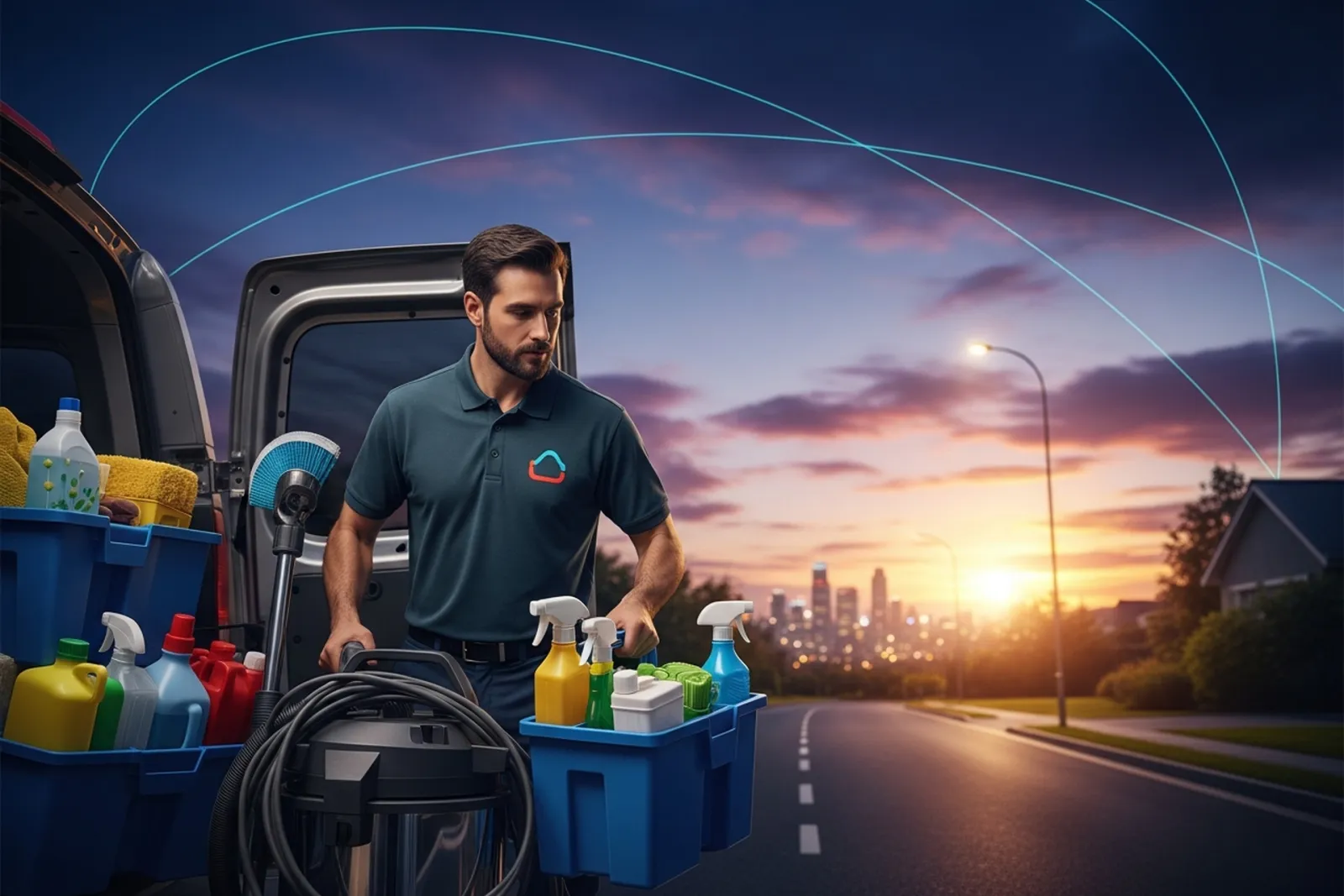
A cleaning business is one of the fastest paths from zero to your first paying customer. Startup costs are low, demand is steady, and you can book revenue in your first week. This guide on how to start a cleaning business skips the generic paperwork lecture and focuses on the decisions that actually shape a cleaning company: who you serve, what you buy, how you price, and how you land your first clients.
Demand is not a question mark. The U.S. employs roughly 2.4 million janitors and building cleaners, with about 351,300 openings projected every year through 2034, according to the Bureau of Labor Statistics. People and businesses will always pay to keep their spaces clean. Your job is to build a company that captures a slice of that demand profitably.
How to start a cleaning business, step by step
Here is the sequence. The rest of the article breaks each step down.
- Choose residential or commercial.
- Buy your starter equipment and supplies.
- Set your pricing model.
- Handle the legal and money basics.
- Get bonded and insured.
- Land your first five clients.
- Turn the plan into real numbers.
Most founders overthink steps four and five and underthink steps one and three. Reverse that instinct.
Step 1: Choose residential or commercial
This is the single most important early decision, because everything downstream flows from it. Residential and commercial cleaning are two different businesses that happen to share a name.
Residential cleaning means homes, condos, and apartments. You work daytime hours, get paid quickly, and can start solo with almost no capital. Clients find you through neighbors, referrals, and local search. The tradeoff is that each account is small, and you replace churned clients constantly.
Commercial cleaning means offices, medical suites, gyms, retail, and other facilities. Contracts are larger and more stable, often billed monthly, and the work usually happens after business hours. The tradeoff is a longer sales cycle, insurance and bonding requirements that are non-negotiable from day one, and clients who expect proof you can staff the job reliably.
A simple rule: if you want revenue this month and you are starting alone, begin with residential. If you have some runway, a sales background, and patience for a two-month close, commercial contracts compound faster once you win them. Many founders start residential to build cash flow, then add commercial accounts once they can hire.
You do not have to choose forever. You do have to choose first, because your equipment, pricing, and marketing all change depending on the answer.
Step 2: Buy your starter equipment and supplies
The reason a cleaning business is so accessible is that the equipment list is short and cheap. Here is a realistic residential starter kit and what each piece roughly costs at 2026 retail prices.
- Commercial-grade vacuum: $150 to $400. The one tool worth not cheaping out on, because you use it every job.
- Microfiber cloths and mop system: $60 to $120. Buy in bulk and color-code by room to avoid cross-contamination.
- Caddy, buckets, and a cordless duster set: $50 to $90.
- Cleaning solutions (multi-surface, glass, bathroom, floor): $80 to $150 for a starting supply.
- Vacuum bags, gloves, and consumables: $40 to $80.
That puts a residential starter kit in the $400 to $900 range before your vehicle. Commercial work adds items like a floor buffer, a wet/dry vac, and larger-format supplies, which pushes the initial spend toward $1,500 to $3,000 depending on the accounts you target.
One choice that increasingly wins clients: use certified safer products. The EPA's Safer Choice program certifies cleaning products that perform well while using ingredients safer for people and the environment. Advertising that you clean with Safer Choice-certified products is a genuine differentiator with families, pet owners, and health-conscious offices, and it costs you nothing beyond a shelf swap.
Keep receipts for everything. Those startup purchases are legitimate business expenses, and clean records make the money side of the business far easier later.
Step 3: Set your pricing model
Pricing is where new cleaning businesses quietly lose money. There are three common models, and choosing the right one for your work matters more than the exact number.
Hourly pricing charges a rate per hour, often per cleaner. It feels safe when you are new because you get paid for the time you spend. The problem is that it punishes you for getting faster. As your skill improves and a job that took four hours now takes two, your income drops. Use hourly only for unpredictable one-time jobs where you cannot estimate scope.
Flat-rate pricing charges a fixed price per visit based on the home or space. This is the model most successful residential cleaners settle on. The client knows exactly what they pay, and you keep the upside when you get efficient. To price a flat rate, estimate the hours a job takes, multiply by your target hourly earnings, and add a margin. Track your actual times for the first month and adjust.
Per-square-foot pricing charges by area and is the norm for commercial accounts. Rates commonly run a few cents per square foot for standard office cleaning, varying by frequency, floor type, and scope. It scales cleanly across buildings of different sizes and is the language commercial buyers expect in a bid.
A practical starting approach: quote residential jobs as flat rates, quote commercial jobs per square foot, and reserve hourly for odd one-time deep cleans. Whatever you choose, price at market from your first client. Discounting to win early accounts locks you into rates you will resent within three months.
For the deeper financial picture, including gross margins, route density, and how a real cleaning company's numbers stack up, our cleaning service business plan walkthrough runs the full model with industry-typical figures.
Step 4: Handle the legal and money basics
You do need to make your business official, but this part is more routine than it looks, and it is the same for a cleaning company as for most service businesses. Rather than repeat it here, follow the sequence that applies to any new venture.
Register your business, get your federal tax ID, and open a dedicated bank account. Our step-by-step guide to registering a business covers the exact order: entity filing, EIN, tax registration, licenses, and the business bank account that keeps your finances clean.
The one structure question worth pausing on is whether to stay a sole proprietor or form an LLC. Cleaning means working inside clients' homes and offices, which carries real liability, so many cleaning founders form an LLC early for the personal-asset protection. Our breakdown of when to switch from sole proprietor to LLC walks through the tax and liability tradeoffs so you can time it right.
For anything specific to your situation, consult a CPA or attorney. Tax treatment and licensing rules vary by state and by the kind of accounts you take.
One classification point specific to cleaning: the moment you hire, be careful about calling cleaners independent contractors. If you set their schedule, dictate their methods, and supply their equipment, they are likely employees in the eyes of tax authorities. Misclassification is a common and expensive mistake in this industry. Build payroll into your pricing before you make your first hire.
Step 5: Get bonded and insured
Cleaning businesses handle keys, work unsupervised in occupied spaces, and use equipment that can damage property. Two protections are standard, and commercial clients will refuse to hire you without them.
General liability insurance covers property damage and injury claims, for example a broken fixture or a slip on a wet floor. It is the foundation policy for any cleaning company and is usually the first thing a commercial client asks to see. The Insurance Information Institute explains what a business owners policy bundles together, which is often the most cost-effective way for a small cleaning business to buy liability coverage.
A janitorial or surety bond protects clients against theft by your business. It is inexpensive, and being "bonded and insured" is a phrase clients actively look for when choosing a cleaner. Put it in your marketing.
Neither is expensive relative to the risk they cover. Treat both as a cost of doing business you pay before your first job, not a nice-to-have you add later.
Step 6: Land your first five clients
Your first five clients are the hardest and the most valuable. They give you cash, reviews, and referrals that make client six through fifty far easier. Here is how to get them without a marketing budget.
- Tell your personal network directly. Message people you know, explain what you are launching, and offer a first deep clean at a small introductory discount applied only to that first visit. Warm contacts convert fastest and refer soonest.
- Claim your Google Business Profile on day one. Local search is how most cleaning clients find a provider. A complete profile with photos and your service area starts building visibility immediately, and every early review compounds your ranking.
- Post in neighborhood channels. Nextdoor and local Facebook groups are where suburban cleaning demand lives. A short, friendly introduction with your bonded-and-insured status and a referral offer works better than any ad.
- Ask every happy client for a referral and a review. Build the ask into your routine after each clean. Referrals are the primary growth engine of nearly every successful cleaning company.
- For commercial, walk in and offer a walkthrough. Local offices, gyms, and clinics often switch cleaners over reliability. A polite in-person introduction and a free walkthrough quote gets you into the bidding conversation.
Aim for density, not spread. Clients clustered in the same neighborhood cut your drive time, which raises your effective hourly rate. One new client per block beats one new client per city.
If you plan to grow into larger facilities, joining an industry body like the ISSA, the worldwide trade association for the cleaning industry, gives you access to standards and certifications that commercial buyers recognize and trust.
Step 7: Turn the plan into real numbers with AI
You now have the shape of a cleaning business: your market, your kit, your pricing, and your first-client plan. The step that separates a good idea from a real launch is putting your specific numbers on paper, including your local rates, your startup costs, your break-even client count, and your first ninety days of marketing.
That is where EntraWorld's AI tools do the heavy lifting. Instead of staring at a blank document, you answer structured questions about your services, your market, and your goals, and the AI business plan generator builds your plan and financial projections around your inputs. You get a lender-ready document and a clear operating roadmap in minutes, then refine it as you learn.
Start building your cleaning business
Starting a cleaning business rewards action over planning paralysis. Pick residential or commercial, buy a starter kit, price at market, get bonded and insured, and go win your first five clients. The founders who launch are the ones who treat step one as a decision to make this week, not a question to research for a month.
Ready to turn this into a real plan? Join EntraWorld free and build your cleaning business plan and financial projections in minutes.
Ready to build your idea?
Start free. The first 5,000 Premium memberships include a full year of every tool.
Join EntraWorld free →