EntraPath Roadmap
How to Grow a Cleaning Business: Price for Payroll, Hire Well
How to grow a cleaning business past yourself: insurance before you hire, pricing that covers labor, your first cleaner, and systems that scale.
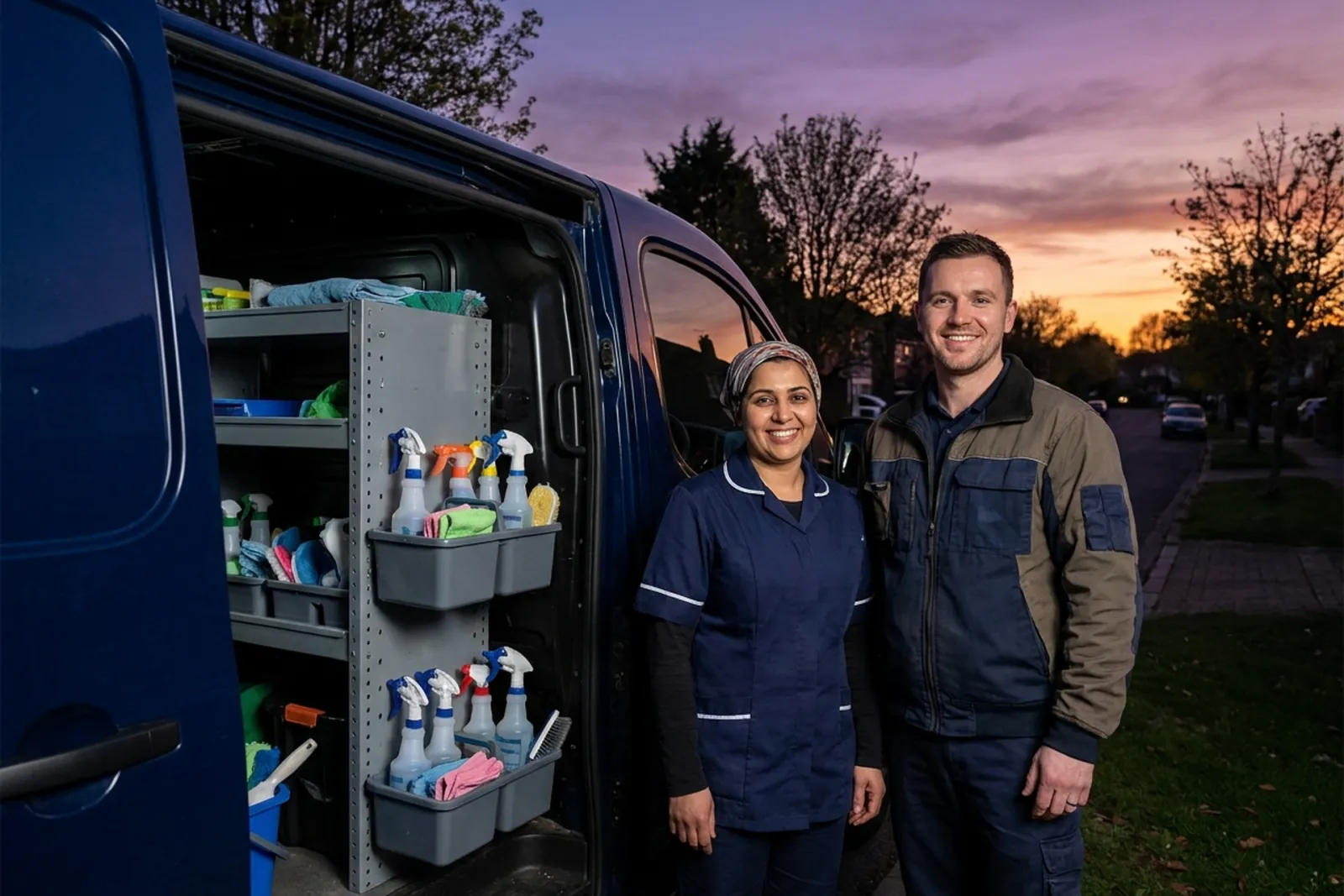
Growing a cleaning business comes down to one choice: keep it a job for yourself, or build a company that keeps running when you are not in the room. Both start the same way, with a vacuum and a first client. They diverge in the first 90 days, when you decide how you price, who you hire, and what you write down. This guide covers that second path, the one that grows from a solo operator into a crew.
If you want the starter checklist (residential versus commercial, equipment, and landing your first five clients), our step-by-step guide to starting a cleaning business covers it. This article picks up from there and focuses on the company you build around the work.
Why a cleaning company is worth building
Demand is steady and the entry barriers are low. The U.S. Bureau of Labor Statistics counts about 2.4 million jobs for janitors and building cleaners in 2025, projects roughly 321,800 openings a year through 2035, and reports that no formal educational credential is typically required. It lists median pay at $17.71 an hour (May 2025).
Two takeaways matter for you. First, the work is accessible, so people can start with little training. Second, that median wage is a useful benchmark for what you will pay a cleaner, and it should shape your pricing from day one.
Your first 90 days of building a crew
Here is the sequence that turns a cleaning job into a company.
- Days 1 to 30: Foundation. Choose your structure, register, get your tax ID, and open a business bank account.
- Days 31 to 60: Protection and pricing. Get insured, build your pricing model, and write your first checklist.
- Days 61 to 90: Your first hire. Bring on one part-time cleaner and measure the results.
Days 1 to 30: make it official
Cleaning means working inside people's homes and offices, so liability is real from the first visit. That is why many owners form an LLC early. Our guide to switching from sole proprietor to LLC lays out the tradeoffs, and the walkthrough on registering a business gives you the exact order of filings. Check with a CPA or attorney on your state's rules.
Days 31 to 60: get covered before your first employee
The SBA's guide to business insurance describes general liability as covering financial loss from bodily injury, property damage, and lawsuits, and a business owner's policy as a bundle that often suits small owners. It also notes that a business with employees needs workers' compensation, with requirements varying by state.
Commercial clients typically ask for proof of coverage before they sign, so ask your agent for a certificate of insurance you can send on request.
Price for payroll, not just for yourself
New cleaners often price by what feels fair for their own hour. A company has to price for what a job costs to deliver, including wages, payroll costs, supplies, and drive time.
Here is a hypothetical example. The numbers are illustrations, not market rates, so replace them with your own.
- A home visit takes two cleaners two and a half hours: 5 labor hours.
- At $18 an hour (close to the BLS median above), wages are $90.
- Assume another 30 percent for employer payroll costs, workers' compensation, and supplies: $27.
- Your delivery cost is $117.
- A $180 flat rate leaves $63, about 35 percent, to cover your driving, scheduling, marketing, and owner pay.
Run the same math before you quote every new job type. If the margin is thin, raise the rate or shorten the scope. EntraWorld's AI financial projections can help you test different wage and pricing assumptions and see where you break even, which is quicker than rebuilding a spreadsheet each time.
For a deeper walk through realistic numbers, see our cleaning service business plan example.
Hire your first cleaner the right way
The first hire is where many cleaning owners make their costliest mistake: treating a cleaner as an independent contractor when the relationship looks like employment.
The IRS looks at three categories of evidence: behavioral control (do you direct how the work is done), financial control (who supplies tools and controls the business side), and the type of relationship (contracts, benefits, ongoing work). It stresses that no single factor decides and that you weigh the whole relationship. If you set schedules, dictate methods, and provide supplies, the IRS guidance on worker classification points toward employee status.
The SBA adds that a worker who meets the legal definition of an employee can leave you owing back taxes and penalties, and it lists the basics of putting someone on payroll: an EIN, a W-4 and I-9 on file, and reporting new hires to your state. Its hiring guide is a good checklist for the paperwork.
What to look for in a first hire
Look for reliability and attention to detail over speed. Skills are trainable with a good checklist. Try a paid trial shift, shadow your first few jobs together, and give feedback the same day.
Train for safety from the first shift
Cleaning products are chemicals. OSHA's Hazard Communication Standard says employers with hazardous chemicals in the workplace must have labels and safety data sheets, and must train workers to handle the chemicals appropriately. Keep a binder or shared folder of the data sheets for every product in your van, and cover them in onboarding.
Build systems that make quality repeatable
A solo cleaner relies on memory. A company relies on checklists. The goal is that a new hire can deliver the same result you would.
Write these four documents in your first 60 days:
- Room-by-room checklists for each service type (standard, deep clean, move-out).
- A first-visit walkthrough that records the client's priorities, access instructions, and any areas to avoid.
- A quality check you complete after each job, with photos if the client allows.
- A client message template for confirmations, running-late notes, and follow-ups.
Cluster clients by neighborhood so crews spend more time cleaning and less time driving. As your list grows, a simple schedule with a standing crew per route keeps customers seeing the same faces.
Use a guided roadmap so nothing slips
EntraPath, EntraWorld's guided founder roadmap, breaks the work into phases from validating an idea to launching and scaling, with task lists for each phase.
Pair it with a plan you can edit as you learn. If you are comparing models before you commit, our overview of service business examples shows how other service founders structure theirs.
When to add a crew lead
Once you have a few recurring routes, you can spend more time on sales and less on cleaning. The signal to promote a crew lead is simple: you are turning down work or doing quality checks at night. Give that person a clear checklist, a small raise, and authority to handle common problems. Our guide on how to scale a business explains how to add capacity without losing quality.
Your next step
Growing a cleaning business into a crew is a sequence of small, concrete steps, and each one makes the next easier. Pick the one in front of you today: register, insure, price, or write the first checklist. When you want the whole path laid out in order, Explore EntraPath and build your cleaning company stage by stage.
Ready to build your idea?
Start free. The first 5,000 Premium memberships include a full year of every tool.
Join EntraWorld free →